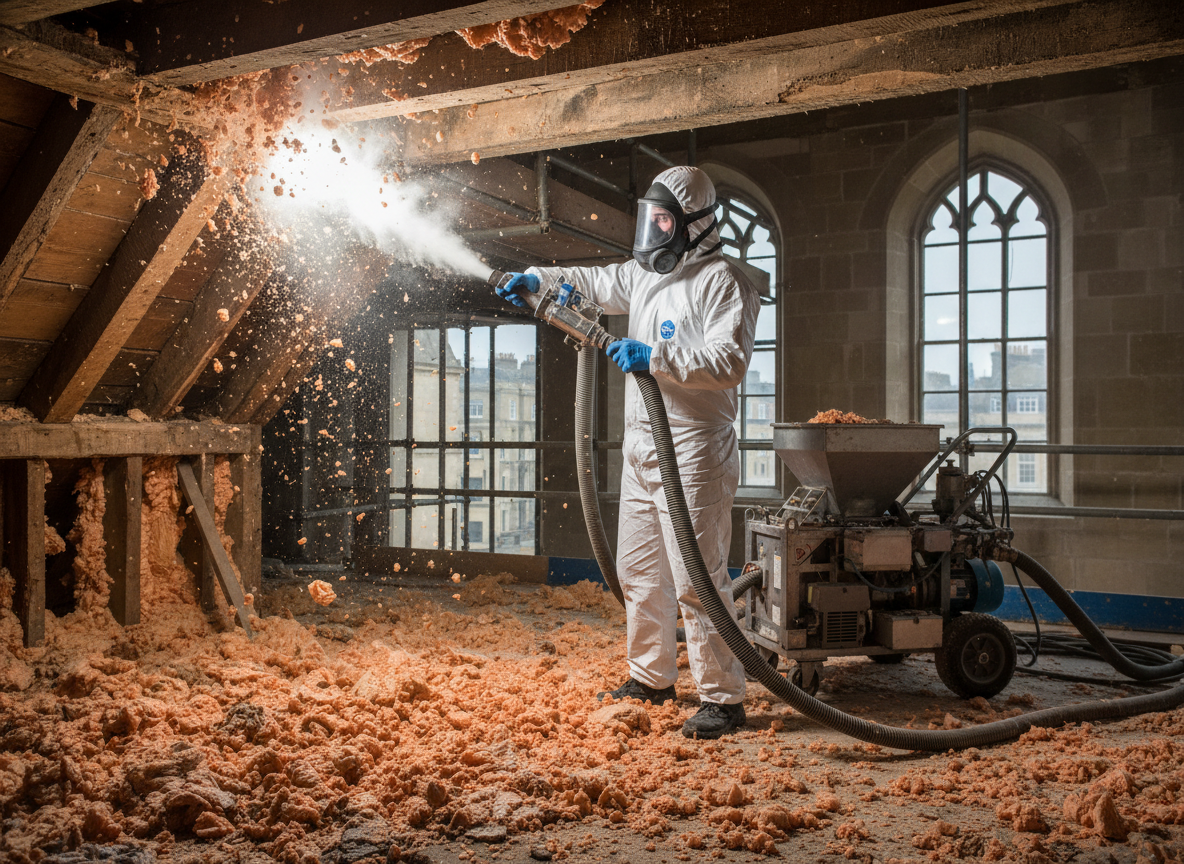
Bath's Georgian townhouses and Victorian terraces often contain closed-cell spray foam applied decades ago to roof voids and under floors. Over time the material traps moisture against Bath stone and timber joists, leading to rot that spreads along the steep gradients common in the city. Dry ice blasting removes the foam by sublimation, leaving no water or grit behind that could worsen damp in properties built on the local clay subsoil.
Access in Circus Mews and surrounding mews cottages is frequently restricted to narrow staircases and low hatches. The process begins with containment sheeting to protect original plasterwork and floorboards, followed by controlled pellet delivery at angles that avoid cracking fragile lath. Operators must monitor CO2 levels in enclosed roof spaces and finish with HEPA vacuuming to capture any loosened debris before it settles into lime mortar joints.
Edge cases include foam that has bonded directly to lead flashings around chimneys or to oak beams in listed buildings. These require lower blast pressures and multiple passes. Homeowners sometimes attempt solvent stripping first, which leaves a sticky residue that clings to the dry ice pellets and creates a larger mess. Professional assessment before work starts prevents this and identifies whether the foam contains asbestos fibres common in pre-1980 installations around the Bath area.
Technician insight
In Bath, the thing that catches most people out with dry ice blasting spray foam removal is how quickly moisture trapped behind the foam has already started softening the original lath and plaster in Georgian ceilings. Once you start blasting, a seemingly solid ceiling can sag if the joists have been sitting wet for years on the local clay.
Mews Cottage Roof Void
Foam in a Circus Mews property had caused persistent damp patches on the bedroom ceiling below. Inspection showed closed-cell material bonded to both the rafters and the back of the lath. Dry ice blasting lifted the foam cleanly without disturbing the historic plaster. The void was left dry and ventilated, stopping further water staining.
How it works
- 1
Site Assessment
Inspect foam depth, substrate condition and access routes through Bath stone properties, noting any listed-building constraints.
- 2
Containment Setup
Seal work zones with sheeting and negative air to protect original features and prevent dust migration into living spaces.
- 3
Dry Ice Blasting
Apply pellets at calibrated pressure to lift foam without abrading timber, stone or plaster surfaces.
- 4
Debris Removal And Final Clean
Vacuum residues and inspect for remaining insulation or moisture issues before handing back the space.
Pricing
Cost depends on foam thickness, access difficulty in older Bath buildings and disposal requirements; site visit provides the accurate figure.