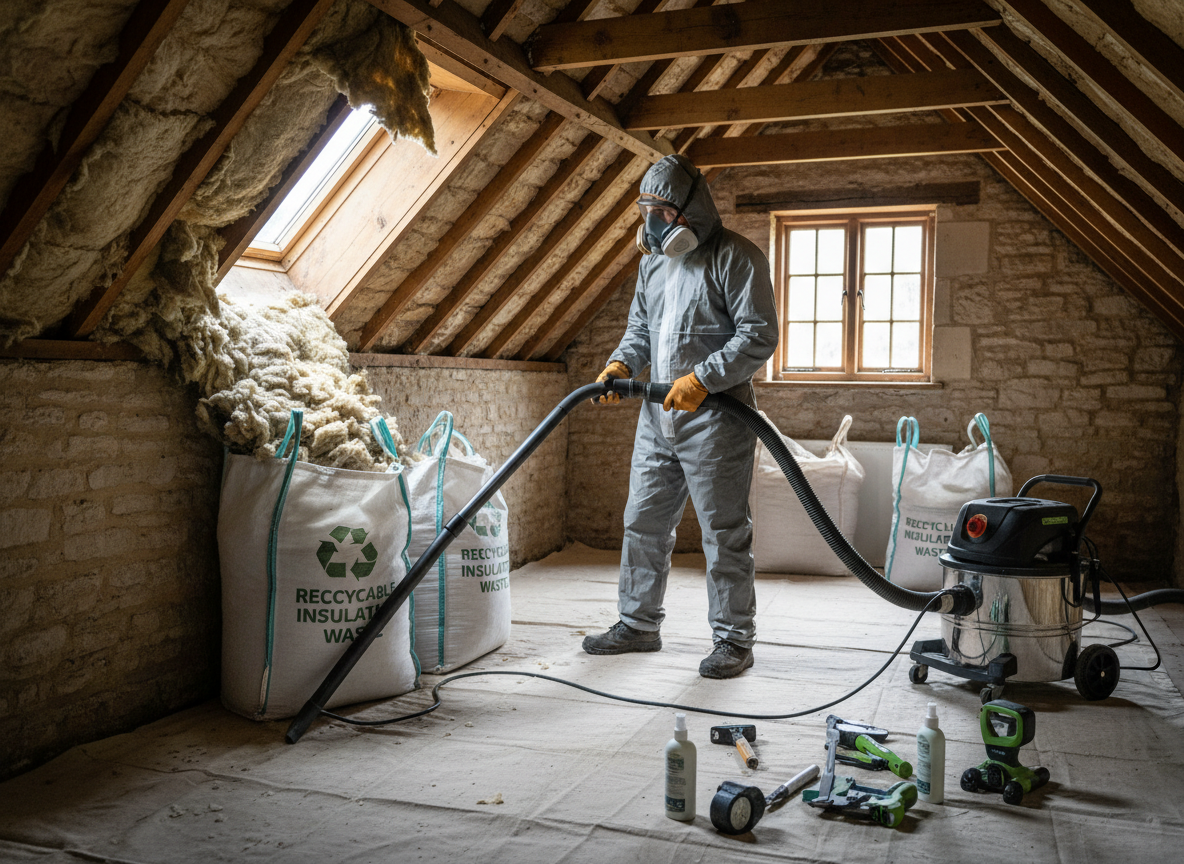
Bath's older housing stock, particularly Georgian terraces and Victorian villas around Circus Mews and the surrounding hills, often received spray foam in the 2000s to combat heat loss through slate roofs. The region's frequent rainfall and high humidity mean foam can trap moisture against Bath stone, leading to timber decay and poor ventilation. Environmentally friendly removal avoids harsh solvents that could stain historic masonry or contaminate local drainage into the River Avon. Instead, crews use controlled mechanical scraping combined with HEPA-filtered extraction to capture particles on site.
Access challenges arise on steep plots common in the Bath area, where scaffolding must be anchored without damaging garden walls or listed facades. Edge cases include foam that has bonded to original lath and plaster ceilings, requiring careful separation to prevent collapse. Disposal follows strict Somerset waste rules by bagging material for licensed recycling rather than landfill. Homeowners notice improved loft airflow within days once the foam is gone, though re-insulation with breathable alternatives is often needed to meet current building standards.
Weather patterns in the Bath area dictate timing. Wet winters make external access slippery and increase the risk of driving rain into exposed roof spaces during removal. Summer jobs benefit from longer daylight but require dust suppression because dry foam dust travels easily through open windows on terraced streets. Technicians always check for hidden electrical cables and pipework before starting, a step that prevents damage in tightly packed period properties where services run through the insulation layer.
Seasonal Guidance
Work scheduled between March and October avoids the worst of Somerset's winter downpours that can turn loft spaces into damp environments mid-job. Early spring removal allows time for any affected timber to dry before new insulation is considered.
Technician insight
In Bath, the thing that catches most people out with environmentally friendly insulation removal is how quickly foam bonds to the back of Bath stone in unventilated lofts on the northern slopes. Homeowners assume a quick scrape will suffice, but the constant damp from the surrounding hills means the material has often wicked moisture into the masonry, requiring extra time to release it cleanly without leaving residue that restarts the rot cycle.
Loft clearance on a Georgian terrace
Foam applied ten years earlier had sealed a slate roof on a property near Circus Mews, trapping condensation against rafters. Inspection revealed early timber staining and blocked airflow. Mechanical removal cleared the foam in sections while protecting original plasterwork below. The loft dried out over the following weeks and natural ventilation returned without further intervention.
How it works
- 1
Site Assessment
Inspect loft or wall cavities in the specific Bath property to identify foam type, depth, and any hidden services or damp issues.
- 2
Containment Setup
Install dust barriers and negative air machines to protect living areas and prevent particles escaping into nearby streets or gardens.
- 3
Mechanical Removal
Scrape and vacuum foam using low-impact tools while separating it from stone, timber, or plaster without chemical strippers.
- 4
Waste Handling
Bag all material on site for transport to approved recycling facilities in line with local Somerset regulations.
- 5
Final Clearance
HEPA vacuum surfaces and ventilate the space to confirm no residue remains before handover.
Pricing
Cost depends on access difficulty, foam depth, and property size; 24/7 quotes available from the Compass Court base.