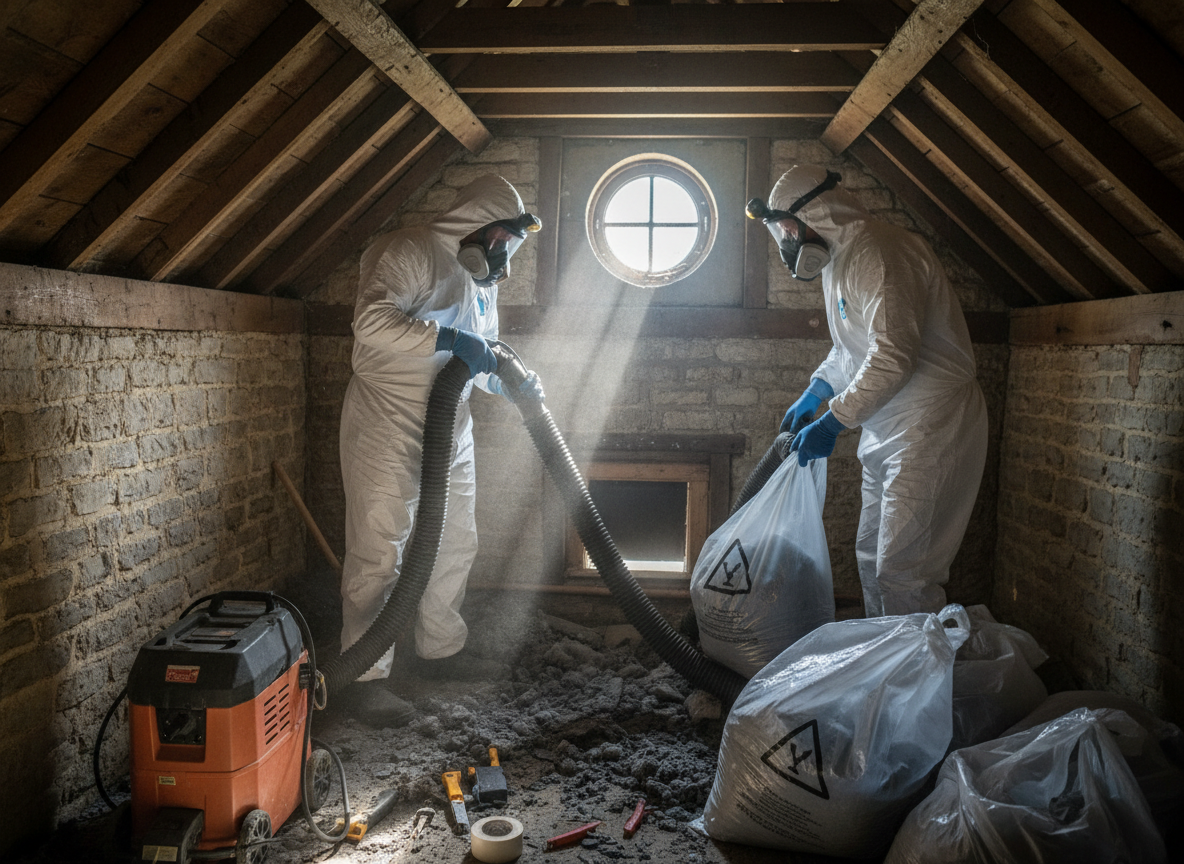
Bath's Georgian and Victorian terraces often have spray foam applied directly to lath and plaster or between rafters in lofts that were never designed for modern insulation. Removing it requires cutting through the rigid polyurethane without tearing the fragile substrate underneath, especially where ceilings sit above occupied rooms in compact Circus or Royal Crescent properties. Moisture trapped against stone walls accelerates foam breakdown, so crews must check for hidden damp before starting any extraction.
Standard removal uses oscillating blades and low-speed grinders to shear the foam from timber or masonry while vacuum extraction captures dust on site. In Bath's narrow mews and steep Lansdown slopes, access often means carrying equipment up multiple flights or through shared hallways, adding time and requiring dust containment to protect neighbouring homes. Older foam formulations sometimes contain legacy blowing agents that release stronger odours when disturbed, so ventilation and PPE protocols are adjusted accordingly.
Homeowners in the Bath area frequently discover the foam has bridged ventilation gaps or blocked eaves, creating condensation issues once it starts to degrade. Careful removal restores airflow while preserving original roof timbers that are now protected features in many listed buildings. Post-removal inspection always includes checking for rot or insect damage that the foam had concealed.
Weather plays a direct role: prolonged winter rain raises loft humidity and makes foam more brittle, while summer heat softens it and increases adhesion to warm surfaces. Jobs scheduled after heavy rainfall require extra drying time before final clearance to avoid trapping moisture in the structure.
Technician insight
In Bath, the thing that catches most people out with insulation removal service is how spray foam bonds to the thin laths in Georgian ceilings; one wrong pull and the whole ceiling comes down, especially in the older terraces around the Circus where plaster is already fragile from age and vibration.
Loft foam removal in a Lansdown terrace
Homeowners noticed musty smells after heavy winter rain. Inspection found spray foam had sealed the eaves and trapped moisture against the stone gable. We removed the foam in sections, restored ventilation, and treated minor timber staining before it spread.
How it works
- 1
Site Assessment
Inspect the property in Bath to map foam locations, check substrate condition, and identify access constraints typical of period terraces.
- 2
Containment Setup
Install dust barriers and negative-air units to protect living spaces and neighbouring properties in dense mews or shared buildings.
- 3
Foam Extraction
Cut and remove the spray foam layer by layer using specialist tools while monitoring for damage to lath, plaster or rafters.
- 4
Clearance and Verification
Vacuum all residues, inspect for hidden damp or rot, and confirm the space meets ventilation requirements before handover.
Pricing
Cost depends on access difficulty, depth of foam, and building age; quotes are provided after inspection.